
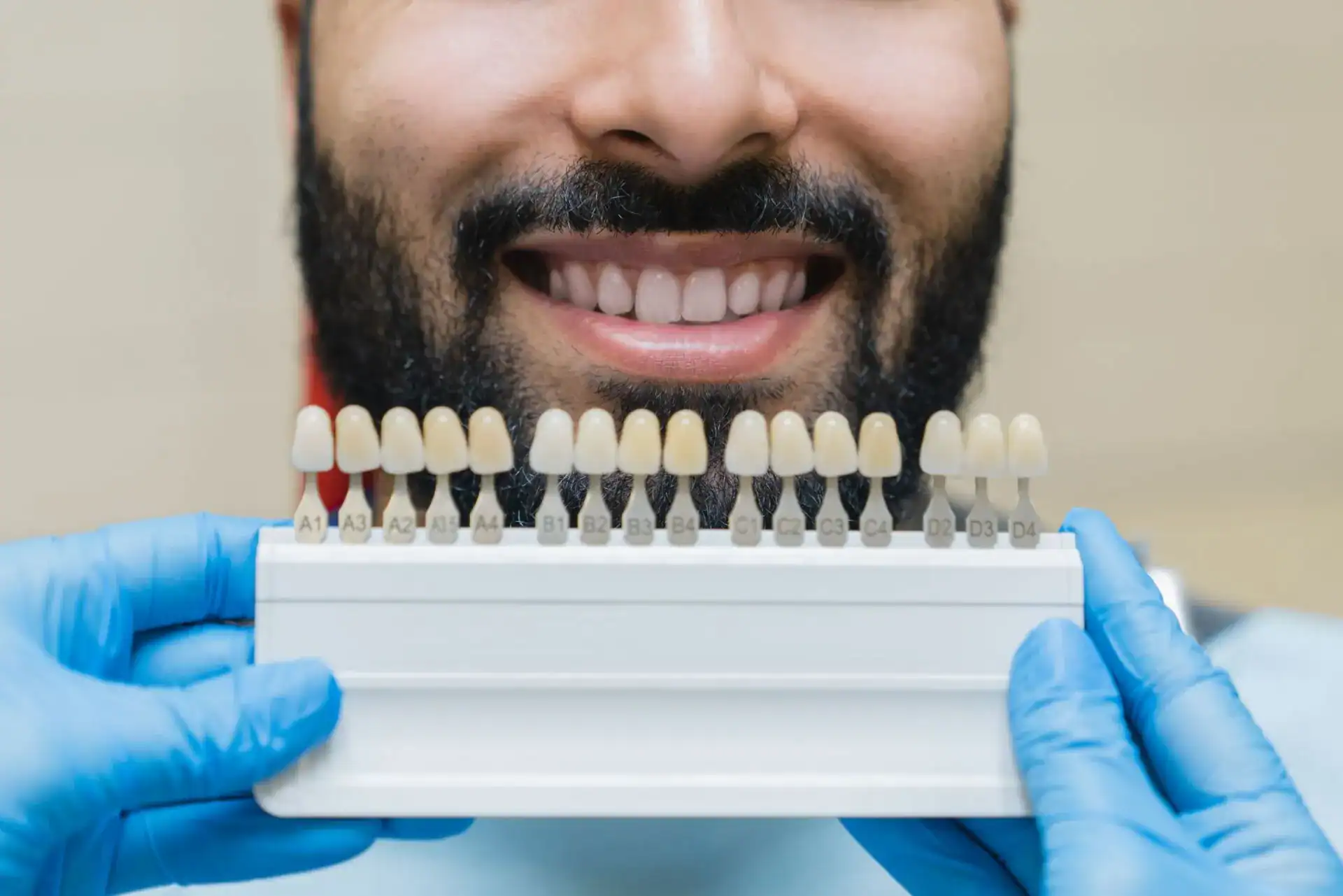
People ask us for the best veneer the way they would ask for the best car. There is no single best answer. One veneer fits a mouth with plenty of enamel and only a small colour change. A different one fits a mouth that is worn down and needs a lot of colour to move. The material follows the mouth, not the other way round.
Here is what actually decides it, and how porcelain and composite compare once you are past the marketing.
What actually decides which veneer fits
Four things matter more than any brand name.
- Enamel — a tooth with less of it has less for any veneer to bond to.
- Bite — grinding puts more force on a veneer's edge than normal chewing does.
- Colour change — a shade off is a different job than a tooth dark from an old root canal.
- Budget — porcelain and composite sit at different price points for a reason, covered next.
A case with plenty of enamel and only a small shade shift is one decision. A case with a dark, worn tooth needing a big colour change is a different one entirely. Both patients may ask for "veneers," but they need different plans.
Porcelain vs. composite, honestly compared
Five things separate them, and none of them is quality.
How each is made
A lab builds a porcelain veneer from a scan of your prepared tooth, then Dr. Tarek bonds it in at a second visit. He sculpts a composite veneer straight onto the tooth, layer by layer, and hardens each layer with a light before polishing it. Composite usually finishes in one visit, with no lab step in between.
Tooth preparation
Porcelain needs room. Dr. Tarek shapes away a thin layer of enamel to make space for the shell, and that shaping does not grow back. Composite works the other way: it adds material on top of the tooth, so it typically removes little to no enamel.
Stain resistance
Porcelain holds its colour well, because glazed ceramic naturally resists stain. Composite resists staining less. Coffee, tea, red wine and tobacco show on it over time in a way they do not show on glazed porcelain.
Repairability
This is where composite has the real edge. If it chips or stains, Dr. Tarek can usually repair or touch it up right in the chair. Porcelain works differently: Dr. Tarek typically remakes a damaged veneer rather than patching it.
Longevity
Porcelain veneers typically last a decade or more with normal care. Composite veneers commonly hold up five to seven years before they want redoing, and polishing along the way can stretch that. Both figures are typical, not guarantees — grinding, staining habits and how carefully Dr. Tarek planned the case all move the number.
Neither material wins on its own. Porcelain is the tool for a case that needs to hold a look for a long time without much upkeep. Composite is the tool for a smaller change, a reversible option, or a lower up-front cost.
Why "minimal-prep" is a question about your teeth, not a product
Some veneers carry a gentler-sounding label: thinner, with less enamel removed, sometimes called minimal-prep or no-prep. They work well on some teeth and not at all on others. It is a candidacy question before it is a choice.
They tend to work on teeth that already run a little small, or that already sit a bit behind the rest of the arch. A thin shell can build those out without looking bulky. They tend not to work on teeth that already sit at a normal size and position. Adding a shell to a tooth that is already the right size leaves it looking too big, and can throw the bite off.
The test is the shape your teeth already are
This is probably the single most misunderstood thing in this category. A minimal-prep veneer is not a lesser or gentler version of a regular veneer that anyone can pick off a menu. It answers a specific starting shape, and an exam tells you whether your teeth are that shape.
Why the enamel question keeps coming back
Every veneer, porcelain or composite, bonds on with a resin cement, and that bond holds strongest and longest when it grips enamel. Dentin, the softer layer underneath enamel, does not hold a bond nearly as well.
That is why "how much enamel is left" is not a small technical detail. It decides how long any veneer holds up, years down the line, no matter which material sits on top. A tooth that has already lost a lot of its enamel makes a harder case for either material. Wear, old fillings and previous dental work all take enamel away. It is worth flagging early, rather than after a veneer starts to fail.
Grinding decides more than the material does
A veneer that chips or comes loose earlier than expected usually points to a bite problem, more often than to the material itself. Grinding puts uneven, repeated force on the front teeth, and a veneer sitting at that edge takes the load first.
We offer nightguards. If grinding shows up during your exam, that conversation happens before a veneer gets planned, not after one has already chipped. Treating the grinding is usually what lets the veneer last as long as the material allows, whichever one you choose.
How the choice actually gets made at Westlake
It starts with an exam, not a menu: we look at how much enamel your teeth have and how your bite loads your front teeth. Then we look at what is actually causing the colour or shape you want to change. From there, Dr. Tarek plans the case with digital smile design, so you can see a preview of the result before anyone touches a tooth.
Where to read more on each one
Our veneers page carries the fuller comparison on porcelain. It walks through the process, the honest cost questions, and what to expect visit by visit. If composite is the direction your case points toward, our composite veneers page covers how it is built and what changes the price. It also says when composite is the wrong tool for a tooth.
When the case needs its own appointment
A bigger case gets its own visit — a fuller smile redesign, a tooth dark from old work, or anything with grafting layered in. That gets planned at the Smile Reveal consult, and the consult is complimentary.
Book an appointment or call the office at (703) 444-5108. We start with the exam that tells us which material actually fits your teeth.
More from the journal
- Same-Day Crowns: Which Teeth Qualify, Which Go to a LabMost single crowns on back teeth can be scanned, designed, milled and fitted in one visit.…
- Can Gum Disease Be Reversed? Gingivitis vs PeriodontitisGingivitis, which lives in the gums alone, can be reversed with professional cleaning and daily…
- Chipped Tooth: When Bonding Is Enough and When It Is NotThe size of the chip and where it sits decide the repair. A small chip in the enamel is…