
It usually turns up in a photograph. The teeth look brighter than they did a month ago, and one tooth near the front sits a shade behind everything around it. That tooth is a crown, and it stayed exactly where it was while the rest of the smile moved.
The short answer is that a crown will not whiten. The useful part is why, because the reason decides the order you do things in.
Whitening changes the colour inside a tooth, not the surface
Whitening gel is hydrogen peroxide, and on a tooth it breaks down into oxygen. That oxygen travels through the enamel and into the dentin, the softer layer underneath.
Dentin carries most of what you see as tooth colour. Large coloured molecules collect there over the years, and oxygen breaks those molecules into smaller pieces that send more light back at you.
So nothing comes off the outside of a tooth during whitening. The structure stays exactly as it was, and only the colour sitting inside it moves.
Porcelain gives that oxygen nothing to work on
A crown is ceramic that a technician builds and fires in a lab, with the colour running through the material itself.
It has no dentin beneath it, no tubules running through it, and no large coloured molecules inside it for oxygen to break apart. The gel sits on the glaze, finds nothing to react with, and leaves the crown at the shade the lab gave it.
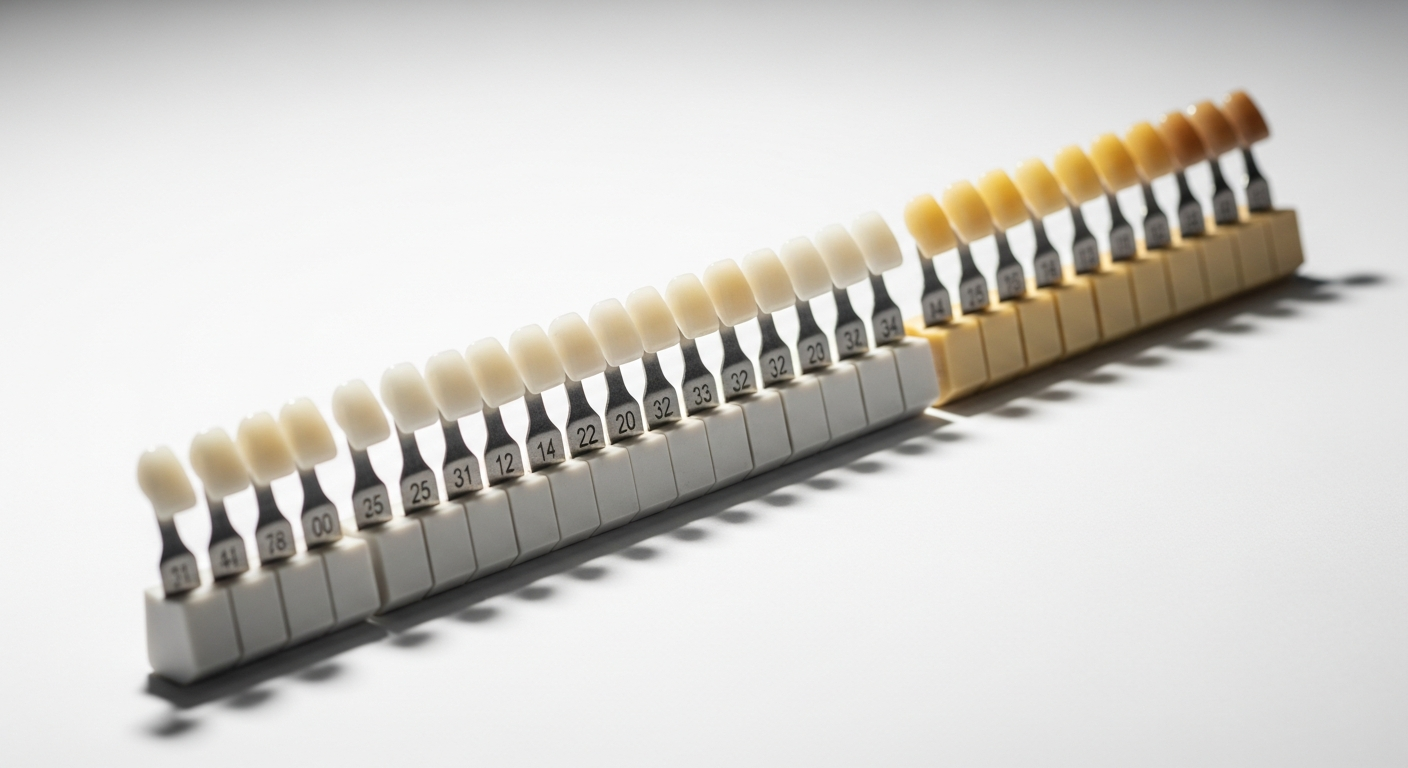
That shade came from a decision somebody made once. We hold a row of shade tabs against your teeth in daylight and pick the closest match. The technician then builds the crown to that number, and ceramic holds its number rather than drifting toward the teeth beside it.
Which material your crown is made from does not change the answer. Zirconia is denser than porcelain, and a metal-ceramic crown carries a metal core under its ceramic layer.
In every one of them the colour was built in at the lab rather than collected over the years. There is nothing stored inside for peroxide to break apart. A veneer or a tooth-coloured filling holds its shade for the same reason.
Crowns do change, but not the way natural teeth do
Coffee, tea, red wine and tobacco leave a film on the glaze, and that film dulls a crown the way it dulls a windscreen. Most people read that dulling as the crown itself darkening, and it usually is not.
A cleaning takes most of the film off, so a crown that has started looking tired often looks noticeably better afterwards. What a polish cannot reach is the colour under the glaze, because that colour is the ceramic.
One habit at home works against that. Whitening toothpastes do most of their work by scrubbing, with abrasive particles that scour stain off enamel, and enamel can take it. A crown's glaze is a thin fired surface, and scouring it day after day leaves it finely scratched.
A scratched glaze grips the coffee film harder and gives less of it up at the next cleaning. The paste bought to brighten the crown is what slowly dulls it, and a plain non-abrasive paste is what keeps that surface smooth.
The gum line is doing something different
The other change happens at the gum line. Gums recede slowly over the years, and the join between crown and tooth comes into view as they go. That dark edge people notice is usually root surface showing above the crown, not stain on it.
The sequence runs one way only
This is the part that costs people money. Natural teeth can move lighter and a crown cannot move at all, so there is one correct order and no route back through it.
Whiten first, take the natural teeth to the shade you want, and then have the crown built to match where they landed. In that order the crown joins the rest of the smile and stays with it.
Reverse it and you own a crown matched to a shade your teeth no longer are. The only way to close that gap is a new crown, because the colour lives in fired ceramic and no gel reaches it.
Give the new shade two or three days before matching anything
Teeth held open and dry through a whitening session look dramatically lighter the moment you stand up. Dry enamel turns opaque, and opaque enamel reads as white to the eye.
Over the following day or two the teeth take water back, and part of that brightness settles out again. The shade at day two or three is the shade you actually have.
Match a crown to the shade you saw on the way out, and you have matched it to a tooth still rehydrating. Waiting a few days is the difference between a crown that sits right and one that sits half a shade off.
When the crown is already the odd one out
Sometimes the whitening has happened and the mismatch is already sitting there. There are three honest routes, and where that tooth sits in the mouth decides which one fits:
- Leaving it alone is a real answer, because a crown on a back tooth rarely shows when you talk or smile.
- Cleaning it closes more of the gap than people expect, when the difference is film on the glaze rather than true shade.
- Remaking it is the only way to move the ceramic itself, and the cost of doing that is what makes the order above worth planning.
Where to start
Mention it early if you have a crown, a veneer or a tooth-coloured filling anywhere in the smile line. That one fact changes the order of everything after it. We look at what those restorations are, what shade they carry now, and whether the plan should end with one of them remade.
If the crown itself is the question, our crowns page walks through how a tooth reaches the point of needing one. If whitening is the next step, start with a cleaning and a look at what the staining actually is.
Book a visit or call the office, and we will hold the tabs against your teeth and tell you what you are looking at.
More from the journal
- How Much Do Veneers Cost? What Sets the Price per ToothVeneers cost is set by the material, how many teeth are in the design, and what has to be fixed…
- How Much Does Invisalign Cost, and What Sets the Price?Invisalign treatment cost is set by how far your teeth have to move, how many aligners that…
- Dentures vs Dental Implants: What Changes Day to DayA denture rests on the gum, so the bone underneath keeps shrinking and the fit keeps changing.…