
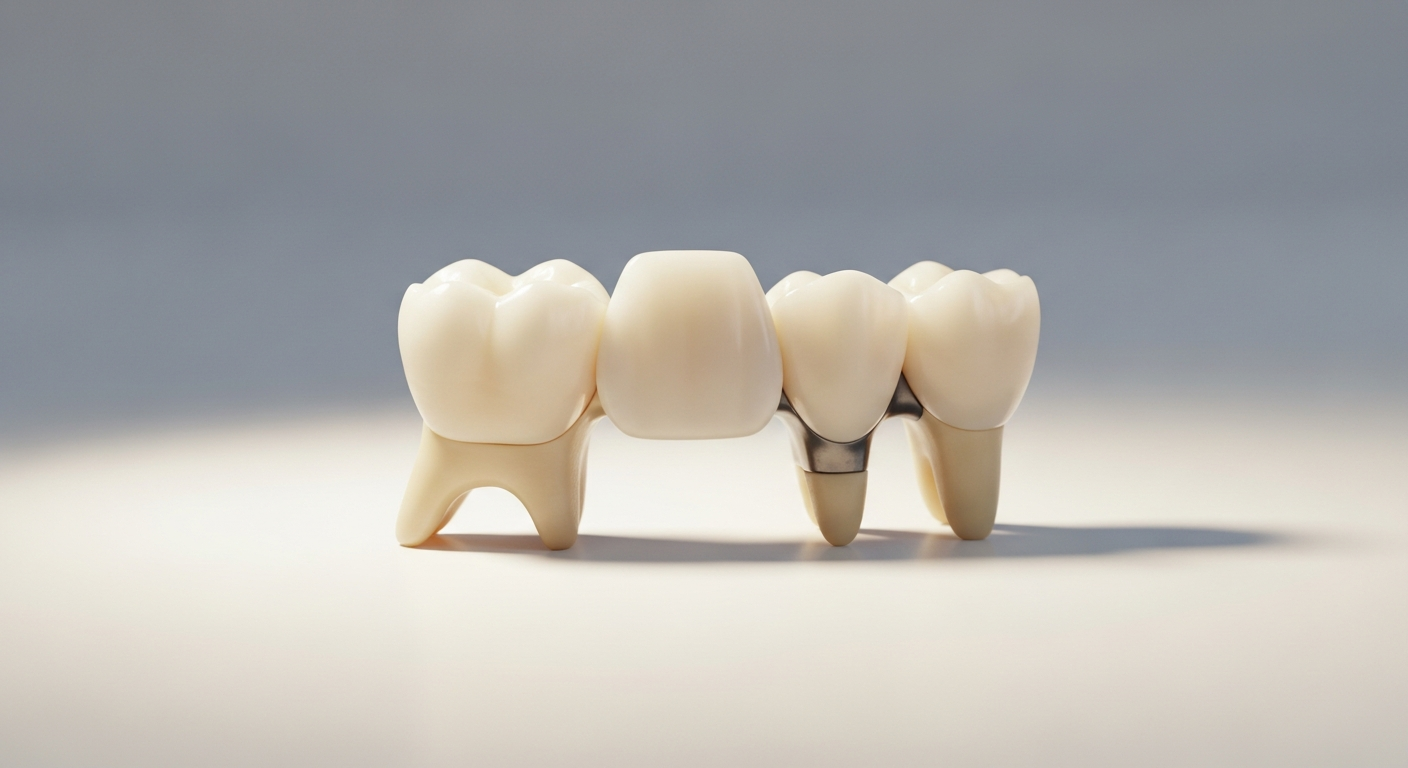
Two people can hear two different words for what sounds like the same problem. One chips a front tooth on a fork and is told a veneer. The other cracks a molar on an olive pit and is told a crown.
From the outside both are a piece of porcelain on a tooth. So the difference gets read as a preference, or as a price tier, and it is neither.
It comes down to two things: how much of the tooth the porcelain covers, and how much healthy tooth comes off to make room.
A veneer is a facing. A crown is a wrap.
A porcelain veneer covers the front of a tooth and stops there. We take a thin layer of enamel off that front surface, and the veneer goes on in its place. The sides, the biting edge and the back of the tooth stay as they were.
A crown covers the whole tooth. We shape it down on every side and across the top, then the crown fits over it the way a thimble fits over a fingertip.
That one difference decides where the strength comes from, and strength is the entire argument.
Where each one gets its strength
A veneer borrows its strength from the tooth underneath. It is thin, and enamel is what holds it — the bond does the structural work, not the porcelain.
A crown supplies its own. Because it goes all the way round, a bite squeezes the tooth inward against a collar of porcelain instead of pushing the walls apart.
So a crown holds a tooth together. A veneer sits on one face of a tooth and holds nothing together. Every recommendation below comes out of that.
Why a cracked back tooth is not a veneer case
A crack in a molar means the two halves of the tooth flex apart a fraction on every bite. Facing the front of it changes nothing about how that load travels, and the halves still move.
There is a second reason, and it is about what the porcelain would stick to. A back tooth that has already cracked usually carries a large old filling. The surface a veneer would meet is filling material and dentine, the softer layer under enamel. Both hold a bond less well than enamel does.
The third reason is geography. The crack runs through the biting surface, and the biting surface is the one part a veneer never covers.
Why a discoloured front tooth is usually not a crown case
Now run it the other way. A front tooth that is sound but dark has a surface problem, not a structural one. Crowning it would mean grinding sound tooth away on all four sides to make room.
That tooth structure does not come back. And the more we take, the closer the shaping gets to the nerve in the middle. A live front tooth prepared for a crown can react months later and need a root canal.
The order we work in
Because of that, we start with whatever removes the least and stop as soon as something solves it:
- Whitening changes the shade of the tooth and removes nothing from it at all.
- Bonding adds composite material to a chip rather than taking any tooth away.
- A veneer takes a thin layer off the front surface and leaves the rest alone.
- A crown takes the most, on every surface of the tooth, and there is no undoing it.
A crown at the top of that list for a colour complaint is a lot of healthy tooth spent on a shade.
The four things we look at
- How much sound tooth is left — a crack, a large filling or a root canal makes it structural, and structural means a crown.
- What a veneer would bond to — enamel holds a veneer, and a front tooth faced in old filling gives it little to grip.
- How you bite — grinding loads porcelain at its edges, so it changes the plan and it changes whether a nightguard goes with the work.
- What the actual complaint is — how a tooth looks and whether a tooth will hold are two different questions with two different answers.
Dr. Tarek reads his own imaging and checks the tooth itself. A crack often shows nothing on an x-ray, so he measures what is left on the tooth in front of him.
Sometimes the answer is neither
If one cusp is weak and the rest of the tooth is solid, an onlay covers that cusp alone and leaves the rest untouched.
If a crack has already run below the gumline, no porcelain of either kind will hold it. That conversation moves from restoring the tooth to replacing it with an implant.
And if the only issue is shade, whitening is the honest first answer even though it is the smallest thing on the list.
Front teeth are a design question too
Front-tooth work is never one tooth in isolation. Shape, edge length and shade all have to agree with the teeth beside them and with your face. That is why front-tooth work starts with a Smile Reveal consult and a digital preview of the proposed smile.
You see the design before anything gets shaped, and you approve it before we start. Nothing is irreversible at that stage.
What to do next
If a back tooth has cracked or lost a piece, the question is structural rather than cosmetic. Our page on crowns in Sterling walks through how we decide and what the appointments involve.
If the tooth is at the front and the concern is shape or shade, start with veneers instead.
If you cannot tell which of the two you are looking at, that is a normal place to be. It is exactly what the exam sorts out.
Book a visit or call the office, and we will tell you which question your tooth is asking and why.
More from the journal
- How Much Do Veneers Cost? What Sets the Price per ToothVeneers cost is set by the material, how many teeth are in the design, and what has to be fixed…
- How Much Does Invisalign Cost, and What Sets the Price?Invisalign treatment cost is set by how far your teeth have to move, how many aligners that…
- Dentures vs Dental Implants: What Changes Day to DayA denture rests on the gum, so the bone underneath keeps shrinking and the fit keeps changing.…