
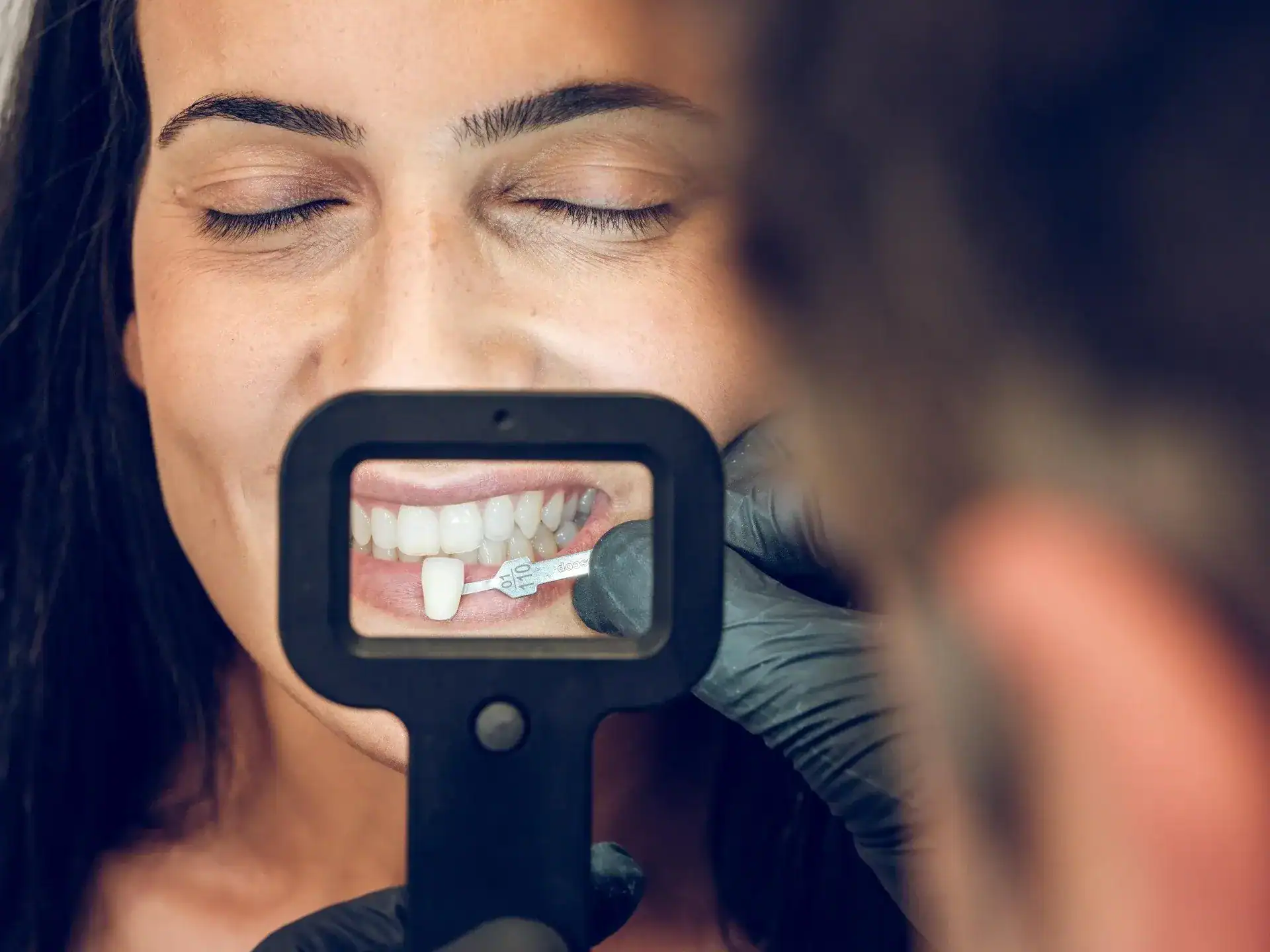
Someone asks "do veneers fall out" for one of two reasons. They're picturing a shell popping loose mid-sentence in a meeting, or they're about to spend real money and want proof it will hold. Both are fair questions, and the honest answer is not a simple yes or no. It comes down to how the bond actually works, because that mechanism decides whether a veneer holds for one patient and loosens for another.
What actually holds a veneer on
Glue sits between two surfaces and holds them together on contact. A veneer's resin cement works differently: it locks into microscopic etched grooves in the tooth's outer layer and forms a chemical bond with it. Once that bond sets, the veneer and the tooth act more like one piece than two things stuck to each other.
Enamel holds a bond. Dentin does not hold it as well.
Here's the detail that ends up mattering most, often years later: enamel takes that bond well. Enamel, the hard outer layer of a tooth, holds a strong, durable bond. Dentin, the softer layer underneath enamel, holds a noticeably weaker one. A veneer bonded mostly to enamel and one bonded mostly to dentin are not the same restoration, even though they can look identical.
Why how much tooth was prepared matters years later
That's why the amount of natural enamel a tooth still has keeps mattering long after the appointment. So does how much the dentist had to prepare away before placing the veneer. A tooth with plenty of enamel left gives the cement more to hold on to. Heavy fillings, years of wear, or an aggressive preparation leave more dentin exposed under the veneer. That bond has less to work with from day one.
A loose veneer usually points at the tooth, not the veneer
When a veneer does come loose, the veneer material itself is rarely the reason. More often, one of a few things is happening underneath it.
The four things that actually loosen one
Heavy grinding or clenching puts far more force on the bond than ordinary biting ever does. An edge-to-edge bite — where the front teeth meet flat-on instead of overlapping — concentrates that force right at the bonded edge. A tooth that had little enamel left before the veneer went on gives the bond less to hold. And moisture that reaches the tooth surface for even a moment during bonding can weaken the bond before a bite ever tests it.
None of this is visible while it is happening
A patient would not notice any of that happening. That's the slightly unsettling part of the honest answer. An appointment years ago, or a habit someone's had for years, usually decides whether a veneer loosens — not anything done wrong that week.
Porcelain and composite fail differently
Both are offered here, and they're worth telling apart, because "does it fall out" has a different answer for each.
Porcelain is a fired ceramic. It resists staining well and holds its shape. But when it fails, it tends to fail all at once: a chip, or the whole veneer coming off as a single piece. We rarely repair a porcelain veneer in the chair; a new one typically replaces it.
Composite fails differently, and can usually be repaired
We build composite veneers up in layers directly on the tooth. They're more likely to pick up a stain or wear at the edges over time than to debond outright. We can often repair a chipped or worn composite veneer chairside, in one visit, without starting over. That repairability is one real trade-off against porcelain's longer-lasting shine.
Grinding causes more early failures than the veneer itself
If we had to name the single habit that shortens the life of veneers, crowns and bonding alike, it's grinding. It happens for many people at night without their knowing. It puts far more force on a bonded edge than eating or talking ever will.
A night guard is the standard answer, and we offer them here. It does not touch how a veneer bonds to a tooth — it simply blocks the force that would otherwise reach that bond overnight. For a patient who grinds, a night guard often makes the difference between a veneer that lasts and one that does not.
If a veneer does come off
It calls for a phone call, not an emergency room visit. Most veneers that come off stay fully intact — keep it, skip any attempt to reattach it, and call us. When the veneer itself has no damage and the tooth underneath looks healthy, we can often re-bond it rather than replace it. We'll want to see what caused it first: a bite issue, a habit, how much enamel remains. Only then do we put it back the same way.
"Permanent" asks the wrong question
Most veneer conversations get a fact backwards here. Preparing a tooth for a veneer — even the light preparation composite needs — removes a small amount of tooth structure that never grows back. That part is genuinely irreversible.
The veneer sitting on top of that preparation is not. It's a restoration, and restorations wear and eventually need replacing, often after many years of normal use. Both facts hold at once: preparing a tooth is a permanent decision, and the veneer itself is a temporary one. Most patients hear only the reassuring half of that sentence.
Where this leaves you
A veneer bonded well to plenty of healthy enamel typically holds up for years of normal use. That holds as long as the bite is not grinding through it every night. None of that is a guarantee. It's exactly why we check enamel and bite before recommending porcelain over composite, or veneers over a different fix.
If you're weighing veneers for the first time, our Smile Reveal consult looks at both before we propose anything. If you already have veneers and one feels off, book a visit or call the office. We'll look at what's actually happening before we tell you what to do about it.
More from the journal
- Same-Day Crowns: Which Teeth Qualify, Which Go to a LabMost single crowns on back teeth can be scanned, designed, milled and fitted in one visit.…
- Can Gum Disease Be Reversed? Gingivitis vs PeriodontitisGingivitis, which lives in the gums alone, can be reversed with professional cleaning and daily…
- Chipped Tooth: When Bonding Is Enough and When It Is NotThe size of the chip and where it sits decide the repair. A small chip in the enamel is…