
A denture can shift when you laugh at the wrong moment. An implant does not, and the difference is not a stronger glue — it is a different kind of hold entirely.
The bond is bone, not suction
A denture stays up through suction against the gum, an adhesive strip, or both. Neither method attaches to anything underneath — it is a seal, and a seal can break.
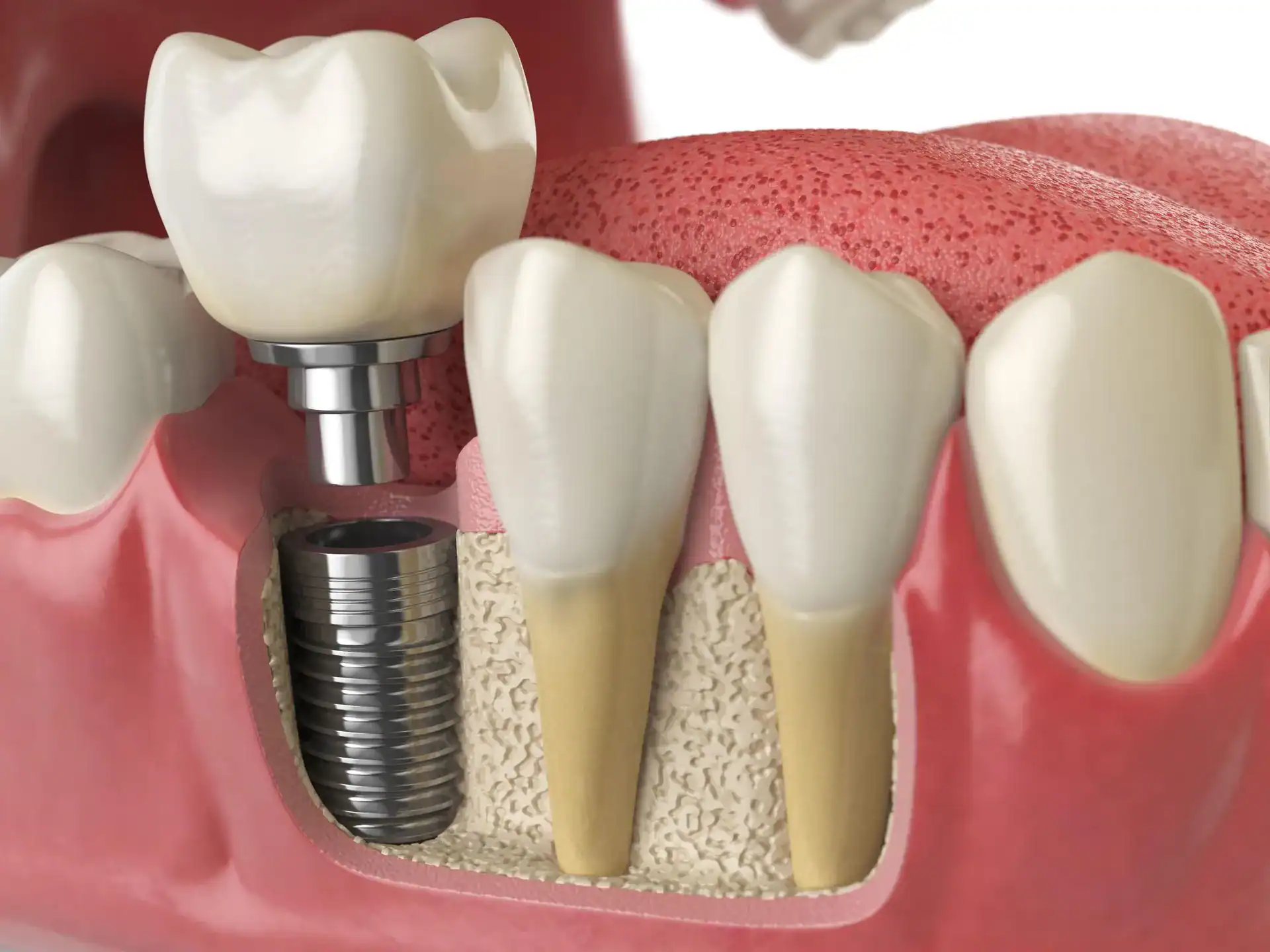
An implant works a different way. The post is titanium, and titanium has a property most materials lack: living bone will grow directly onto its surface. Bone locks into that surface, cell by cell, with no soft tissue layer in between. Dentistry calls this osseointegration — osseo for bone, integration for becoming one structure with it.
What the bond actually changes
Once that bond forms, the post stops being something sitting in the jaw. It becomes part of the jaw, the same way bone anchors a natural tooth root rather than a socket merely holding it in place. That bond is the whole answer to how an implant stays put.
Why the wait matters more than the surgery
The post goes in during a short surgical appointment. The months that follow are where the implant actually becomes stable, and skipping ahead is the most common way an implant fails.
Fresh bone around a new implant is soft, because it has not finished forming its structure yet. It needs time, undisturbed, to mature into something dense enough to carry a bite.
Why the crown does not go on the same day
Loading it too early can disrupt the bond before it fully forms. Think of stepping on wet concrete before it hardens: the surface takes a footprint it should never have taken. The crown does not go on the same day as the post for the same reason. The wait is not caution for its own sake, and it is the bone finishing the one job that makes everything after it possible.
An implant is three parts, not one
People use "implant" loosely for the whole visible tooth, which gets confusing once you look at the actual pieces, because there are three.
The three parts, and which one moves
The fixture is the titanium post inside the bone. Osseointegration bonds to this part, and once it has healed it should not move at all. The abutment is a small connector that attaches to the top of the fixture and sits just above the gum. The crown — or, for a full arch, a bridge or denture — attaches to the abutment. It is the only part anyone else ever sees.
When something does move, it is usually the connection
Long-term movement almost always traces to the connection between these parts, not to the fixture itself. An abutment can loosen over time, and a crown can wear or chip. If a restoration ever feels loose, that is worth a call. It is usually a different problem from an implant loosening in the bone, which is rare once osseointegration has completed.
Why the bone has to be there first
Osseointegration needs bone to bond to. That means the jaw needs enough of it, shaped the right way, before an implant can be placed. A jaw that has been missing a tooth for years often does not have that anymore. The ridge narrows and thins once nothing is biting down on it.
What happens when the bone is not there yet
When that happens, the plan usually adds a step rather than ruling out the implant. Bone grafting builds up the site with additional bone material, and ridge augmentation reshapes and widens a narrowed ridge. A sinus lift raises the sinus floor in the upper back jaw, where natural bone often runs thin. Each of these gives osseointegration a foundation to work with. We evaluate this at the planning stage, before we ever set a date for surgery.
Where the position gets decided
The part of this process most people never hear about happens before any instrument touches the mouth. We take a CBCT scan, a 3D image of your jaw. We use it to map exactly where the implant should sit, relative to the nerve, the sinus, and the surrounding bone.
What "guided" actually means
That plan becomes a surgical guide, printed specifically for your case. It fits over the teeth during surgery and directs the placement to the exact position the plan calls for. The angle, the depth, and the spot get set on the screen beforehand, not judged in the moment. That is what "guided" means in guided implant surgery. It is also a large part of why a well-planned implant integrates the way it is meant to.
What actually threatens an implant, years later
The fixture itself, once integrated, holds up well over time, but gum disease around the implant is a real long-term risk. It is called peri-implantitis: inflammation of the tissue and, eventually, the bone surrounding it.
It behaves like gum disease around a natural tooth. Plaque builds along the gum line, the tissue inflames, and left untreated, the bone holding the implant can recede. That bone is the entire foundation osseointegration built.
Protecting it is the real long-term job: daily cleaning around the implant, the same as around a natural tooth. It also means the checkups where we can catch early inflammation before it reaches bone.
Getting the exam that answers your case
Every question here is specific to your jaw. That includes how much bone you have, what a scan would show, and what a guide would map out. The exam is where it gets answered.
If you are weighing an implant against other ways to replace a missing tooth, our dental implants page covers the options. Cases involving grafting, a full arch, or added complexity are the kind the Smile Reveal consult is built to plan properly.
Book an appointment or call the office, and we will start with the scan that tells us what your case actually needs.
More from the journal
- Same-Day Crowns: Which Teeth Qualify, Which Go to a LabMost single crowns on back teeth can be scanned, designed, milled and fitted in one visit.…
- Can Gum Disease Be Reversed? Gingivitis vs PeriodontitisGingivitis, which lives in the gums alone, can be reversed with professional cleaning and daily…
- Chipped Tooth: When Bonding Is Enough and When It Is NotThe size of the chip and where it sits decide the repair. A small chip in the enamel is…