
You have a gap, and you have heard two words for fixing it: implant or bridge. They sound like two prices for the same tooth. They are not, because they fill the gap in different ways and the difference sits in the teeth on either side.
That makes dental implants vs a bridge a question about your other teeth as much as the missing one. This guide covers what each option does to them and what the research says goes wrong with each. It also says when a bridge is the right call.
How does a bridge hold a tooth in place?
A conventional bridge is a span of three connected pieces. The replacement tooth in the middle is called a pontic, and it attaches to nothing underneath, so it simply rests above the gum. All of its support comes from a crown on each neighboring tooth. The American Dental Association describes a bridge as "attached to surrounding teeth for support."
To carry that span, each neighboring tooth has to be shaped down to fit a crown. A laboratory study on model teeth measured what a full crown preparation takes from a back tooth. It removed 67.5 to 75.6 percent of the crown by weight. Enamel does not grow back, so those teeth stay crowned for life, even if they were healthy when you walked in.
A bridge is a laboratory case. We prepare and scan the teeth at the first visit, fit a temporary bridge, then seat the finished one when the lab returns it. That makes two visits, and never a same-day bridge.
What does an implant do differently?
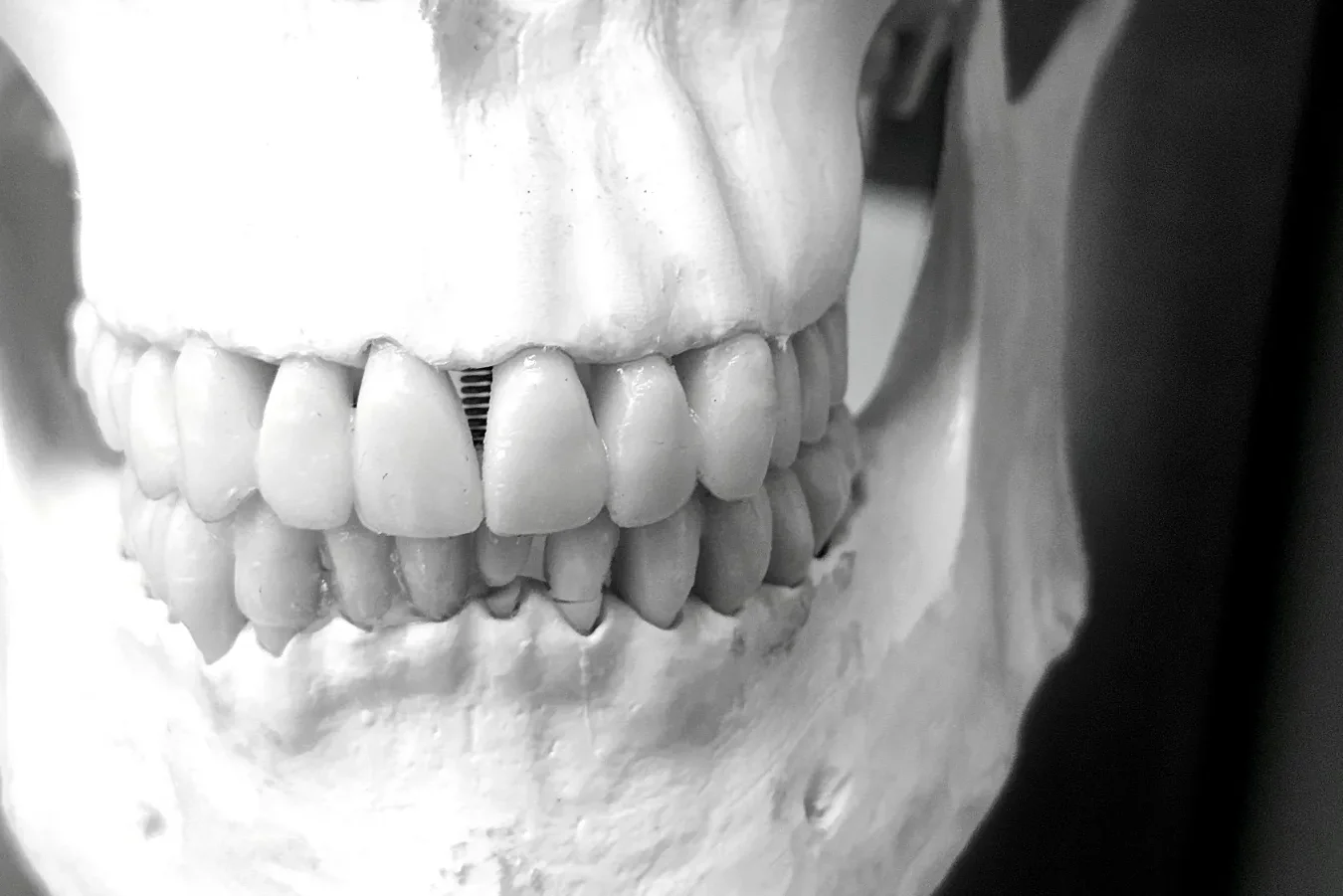
An implant replaces the root rather than borrowing from the neighbors. A small post goes into the jawbone, bonds with it, and carries its own crown. The teeth on either side are left exactly as they were. How dental implants stay in place covers the bonding step in detail. The dental implants page covers the options for one tooth, several teeth or a full arch.
The root also matters to the bone. Bone keeps what it uses, and a tooth root passes the force of every bite into the jaw. A systematic review of human studies tracked sockets left to heal on their own after an extraction. Within six months the ridge lost 29 to 63 percent of its width and 11 to 22 percent of its height. The loss came fastest in the first three to six months.
A bridge does not change that, because the pontic rests on the gum and sends no bite force into the bone under it. An implant is the option that again passes bite force into the bone under it.
The root canal and extraction guide covers what an empty socket does over the first year, including to the teeth beside it. Single tooth replacement covers the implant route for one tooth.
What goes wrong with each one over time?
The most useful evidence here is a systematic review that pooled studies of both options, each with a mean follow-up of at least five years. It was published in 2007, so the figures describe older cases. After 10 years, an estimated 89.2 percent of conventional bridges and 89.4 percent of single-tooth implant crowns were still in function.
What differs is the kind of trouble that shows up in each. For conventional bridges, the most frequent complications were biological: caries and loss of pulp vitality. That means decay under the crown edges, or a nerve in a prepared tooth that stops being healthy. This is the neighbor cost showing up in the data. For implant restorations, the technical problems were more frequent: chipped porcelain, loose screws and crowns that lose their grip.
Implants carry a biological risk of their own. A 2012 review of implant-supported bridges counted infection and soft tissue problems around the implants in 8.5 percent of them over five years. Implants need the same careful cleaning as natural teeth, and a regular checkup is part of the plan.
Cleaning is also where the two differ day to day. A bridge is one connected piece, so floss cannot slide down between its teeth the usual way. The American Dental Association notes that people with bridges may find a water flosser helps them reach every nook. A single implant crown is cleaned like any other tooth.
When is a bridge the honest answer?
When both teeth beside the gap already need full crowns anyway. A bridge then takes nothing extra from those teeth, because the shaping was going to happen regardless.
A bridge can also suit someone who cannot have surgery, does not want it, or needs the gap closed sooner than an implant allows. An implant has to bond with the bone before the final tooth goes on, so it generally takes longer. We do both at Westlake. The dental bridges page lays out the bridge side in full, and the dental crowns page explains what the crowns on a bridge involve.
Several teeth missing in a row is a third case. An implant-supported bridge uses implants instead of natural teeth to carry the span, so the remaining teeth are left alone.
What does the exam look at before choosing?
Four things decide the choice, and none of them is a guess made from across the room.
-
The neighboring teeth: whether they are healthy and untouched, or already heavily filled, cracked or due for crowns.
-
The bone, measured for height and width on a 3D scan. If there is not enough, bone grafting may come first. Read whether you need a bone graft for how that call gets made.
-
The gums, since inflammation around an implant is the biological risk counted above.
-
Your bite, because the new tooth has to meet the opposing teeth without taking more force than it can carry.
Placing an implant is oral surgery, and comfort options are discussed at the visit. The oral surgery page covers what that involves for the patient. If the gap is part of a larger plan, such as several teeth, the complimentary Smile Reveal is where an implant case is planned.
Common questions
Will a bridge hurt my neighboring teeth?
It changes them for good. Each supporting tooth is reshaped for a crown, and the review above found decay and nerve problems were the commonest complications on conventional bridges. Most bridges are still in function after 10 years. What you give up is part of two teeth, and each of them then carries part of a third tooth's load.
Is an implant always better than a bridge?
No. An implant suits a gap beside healthy teeth with enough bone. A bridge suits teeth that already need crowns, or someone who cannot or would rather not have surgery. The exam is what decides it.
How do I compare the two when I get quotes?
Ask for each option written out as the whole path from start to finish, not just the first visit. Include what comes after, such as the temporary, any bone work and the checkups. Then compare what each plan asks of the teeth beside the gap, because that part cannot be undone.
What if I have already lost several teeth in a row?
You have three options rather than two: a conventional bridge on natural teeth, an implant for each missing tooth, or an implant-supported bridge. The scan shows which of them the bone can support.
Your move
Bring your X-rays along if you have them, and we will start from there. We will look at the teeth on both sides of the gap and the bone beneath it. Then we will show you what each option would ask of them. Book an appointment or call the office at (703) 444-5108.
More from the journal
- Is Charcoal Toothpaste Safe for Your Teeth?Charcoal toothpaste can scrub off some surface stain, but it cannot change the color inside a…
- How a Smile Makeover Is Planned Before Any Tooth Is TouchedA smile makeover is planned in a fixed order: records, a digital design built around your face,…
- Is Flossing Actually Necessary? What the Evidence SaysCleaning between your teeth is necessary. The 2016 headlines were about short, weak studies,…