
Maybe a dentist mentioned a graft when you asked about replacing a tooth. Or you lost a back tooth years ago and wonder whether you waited too long. Whether you need a bone graft for a dental implant comes down to one measurement: how much bone is left where the tooth was. That amount changes after a tooth comes out, and it changes in a predictable way.
Why does the jawbone shrink after a tooth is lost?
The ridge of bone that holds your teeth is there because of the teeth. Each root sits in a socket, and the thin layer lining that socket is bone the tooth anchors itself to. When the tooth goes, that layer has no job left, and the body breaks it down.
A 2005 study by Araújo and Lindhe followed this in extraction sockets under the microscope. The study was in dogs, but it showed the pattern clearly. The top edge of the cheek-side wall is made entirely of this tooth-bound bone. So that wall lost more height than the tongue-side wall over the eight weeks the study followed.
In people, the numbers come from a 2012 systematic review in Clinical Oral Implants Research that pooled 20 studies. Six months after an extraction, the ridge had lost 29 to 63% of its width and 11 to 22% of its height. The loss was fastest in the first three to six months and slowed after that.
Upper back teeth have a second problem. Their roots sit just below the maxillary sinus, the air space above the upper jaw. After those teeth come out, the sinus floor tends to drop into the space.
A 2008 radiographic study in the International Journal of Oral & Maxillofacial Implants measured it on X-rays taken before and after extraction. The sinus expanded downward after upper back teeth were removed, and more so after second molars and when two or more neighboring teeth came out. So the bone there thins from the top as well as from the sides.
What happens if there is not enough bone for the implant?
An implant is a titanium post that bone grows onto. Our post on how implants stay in place covers that bond in detail. The short version is that the post needs bone on every side, and it needs to hold still while that bone grows onto it.
If the ridge is too narrow, part of the post ends up with no bone covering it. If it is too short, the post runs out of room before it is long enough to hold. Thin bone also gives the post less support during healing, and a post that moves ends up wrapped in soft tissue instead of bone. Our post on why implants fail walks through that problem.
Waiting makes the gap bigger. The ridge keeps shrinking after those first months, just more slowly.
How is it decided whether you need a bone graft for a dental implant?
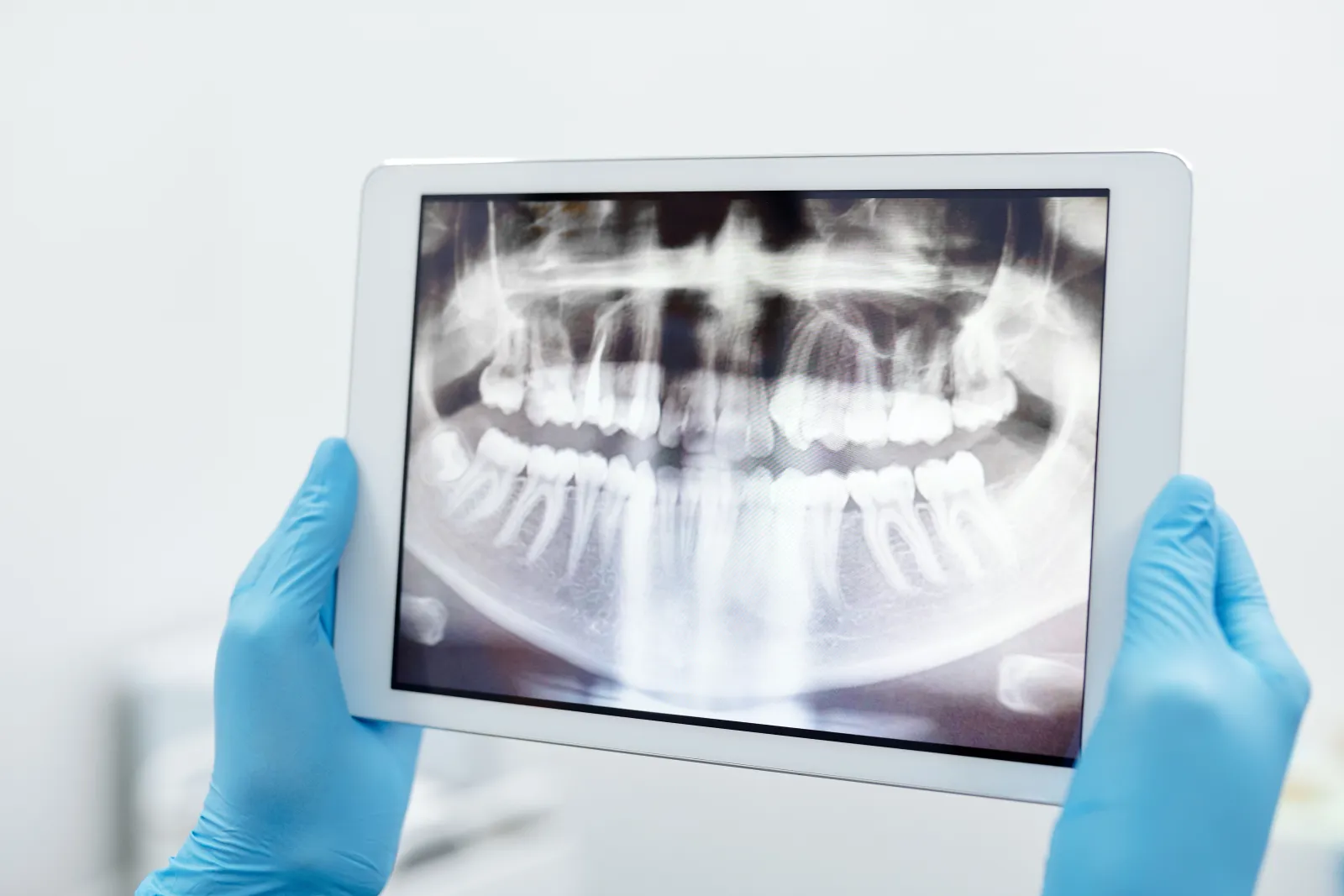
A regular X-ray is flat. It shows how tall the bone is, but not how thick it is from cheek to tongue. The decision needs that thickness too, which is why we plan implants on a 3D scan of the jaw. The scan shows how wide and how tall the bone is at the exact spot the implant would go. It also shows how close that spot sits to the sinus above or the nerve that runs through the lower jaw.
From the scan, the implant is planned on the computer before anyone touches the site. If the planned post fits inside the bone with bone around it, no graft is needed. If the post would stick out of the side of the ridge, or reach the sinus, the plan includes a graft. We print a surgical guide from that plan, shaped to your own teeth and gums, to steer the drill to the planned spot. You see the scan and the plan before you decide anything.
Whether a graft is part of the plan also changes the number of visits and the quote. That is one more reason the scan comes before either one.
What are the three kinds of bone graft?
Graft material comes from four sources: your own bone, processed donor bone, processed animal bone, or a synthetic mineral. A 2013 review of bone grafts in dentistry describes each. The material works as a frame. Your own bone grows into it and, over time, usually replaces it completely. Where it goes depends on which of these three situations you are in.
A socket graft at the extraction
When a tooth that will be replaced has to come out, graft material can go into the empty socket at the same visit. This is called ridge preservation. It works with the timing above: it protects the ridge while the ridge is still whole, before the fastest shrinking happens.
It does not stop the shrinking altogether. A 2021 Cochrane review pooled the trials on it. Sockets grafted with animal-derived bone kept about 1.2 mm more width and 1.4 mm more height than sockets left to heal alone. The reviewers rated that evidence very uncertain. They also found no clear difference in how often a second graft was needed later, or between the graft materials tested.
Ridge augmentation where the ridge has thinned
If the tooth has been gone a while, the ridge is often too narrow or too short. Ridge augmentation adds graft material to the outside of the ridge to rebuild its width or height.
A sinus lift for upper back teeth
When the sinus has dropped, there is not enough height above the upper back ridge. A sinus lift raises the thin membrane lining the sinus floor and places graft material underneath it. That builds height from above, where the ridge cannot be built up from below.
All three are done in-house at Westlake as part of our oral surgery care, planned on the same scan as the implant. Oral and maxillofacial surgery is its own specialty, and complex cases that need that level of surgery are referred out.
When is a bone graft not needed?
You do not need one when the scan shows the planned post fits inside the bone you already have, with bone on every side. That is more likely when the ridge was thick to begin with. It is also more likely when a tooth is replaced soon after it comes out, before the fast shrinking of the first months. Full-arch treatment such as All-on-4 is planned the same way, on the bone the scan shows. The scan is what tells you which group you are in.
How long does a bone graft take to heal?
It varies too much to promise a date. A small socket graft and a large ridge rebuild heal on different schedules. When the graft is done first, the implant waits until the new bone is ready to hold it.
What to expect when getting dental implants covers the stages that follow. Comfort options for the surgery are something we talk through with you beforehand.
Find out what your scan shows
Thinking about a dental implant, or have a tooth that needs to come out? The scan answers the graft question for your mouth. Book an appointment or call (703) 444-5108.
More from the journal
- Do Dental Implants Hurt? What You Feel, and WhenDuring implant surgery most people feel pressure and vibration, not pain, because the area is…
- Invisalign vs Braces: What Decides Which One FitsInvisalign vs braces comes down to how each one pushes teeth and how your bite is built. Here…
- What Happens at a Dental Implant Consultation?A dental implant consultation is a measuring and planning visit: your health history, an exam,…