
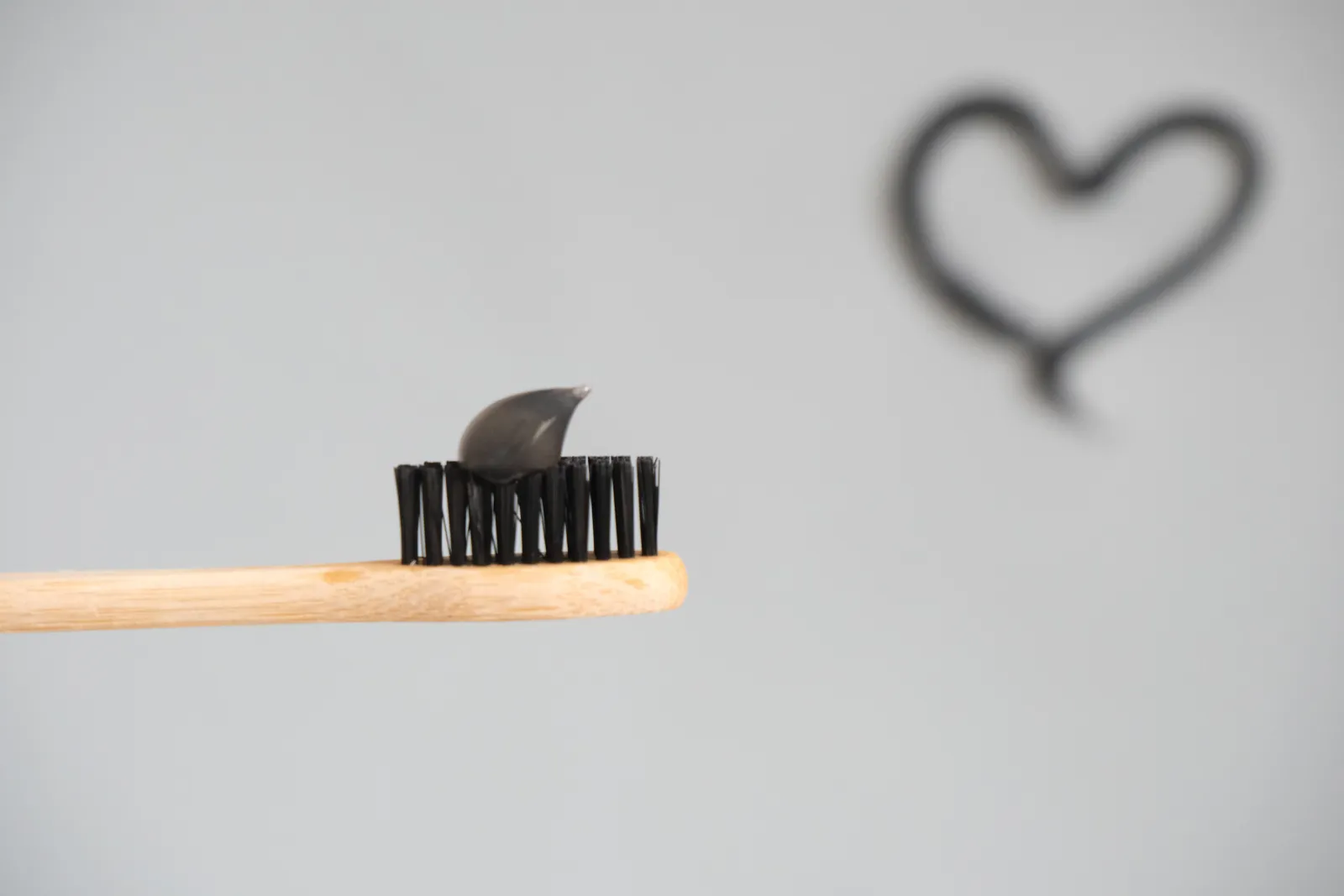
Charcoal toothpaste is the black paste that foams grey and leaves the sink looking like a fireplace grate. It is sold as a quick, easy way to whiten teeth.
So does charcoal toothpaste work for teeth whitening? It can lift some stain from the surface of a tooth, but it cannot change the color inside the tooth. And the way it lifts stain from the surface is the same way it wears enamel down.
How does charcoal toothpaste whiten teeth?
Teeth carry two kinds of stain, and they sit in different places. Surface stain sits on the outer layer of enamel, where coffee, tea, red wine and tobacco all leave it. Deeper color sits inside the tooth, in the dentin under the enamel.
Enamel is partly see-through, and the dentin beneath it is yellowish. Part of the color you see in a tooth is that dentin showing through.
The ADA's guidance on toothpastes separates these two jobs. Abrasives in a whitening paste may whiten teeth by physically removing surface stains. Hydrogen and carbamide peroxide are what lighten intrinsic stains, the color inside the tooth.
Charcoal belongs in the first group, because its particles are gritty. Brushing drags them across the enamel like a scouring pad across a pan, which can take off a film of coffee stain. It does nothing to the dentin, because grit never gets past the surface it is rubbing.
The lab research lines up with that: a 2022 systematic review of 11 lab studies found charcoal pastes whitened less than other whitening pastes. Most of those studies also found the charcoal pastes more abrasive.
A 2024 lab study on stained enamel found charcoal paste and powder changed the color no more than ordinary toothpaste did. Both charcoal products still left the enamel softer and rougher than before.
Charcoal ads often add that it kills bacteria or "detoxes" the mouth. A 2017 review in the Journal of the American Dental Association found the antibacterial and detox claims in the ads unsupported. It also found too little data to support the safety or effectiveness claims.
Is charcoal toothpaste bad for your enamel?
Enamel has no living cells, so it cannot repair damage from wear. What wears away does not grow back, and every brushing with a gritty paste takes a very small amount.
All toothpaste is a little abrasive, and the ADA measures abrasiveness on a scale called RDA. A paste at or below 250 RDA is considered safe and effective, and every paste with the ADA Seal must meet that limit.
The problem with charcoal pastes is how much they vary from one formula to the next. A 2022 lab study brushed human dentin for four hours with electric toothbrushes and three charcoal pastes. One paste removed about 71 micrometers of dentin, against about 28 for plain water. The other two were not measurably different from water.
So the risk comes from the grit in a given formula, and the black color tells you nothing about which kind you are holding.
Dentin matters here because it is less dense than enamel, and it is left exposed when gums recede. Dr. Tarek sees the same kind of wear in patients who brush too hard or use a hard-bristled brush. A gritty paste adds to that wear rather than replacing it.
Worn enamel also brings its own color problem. As enamel thins, more of the yellowish dentin shows through, so a paste bought to brighten teeth can leave them looking more yellow over time. Our post on enamel erosion and acid reflux explains how acid thins enamel too, adding to any wear from brushing.
Does charcoal toothpaste have fluoride?
Often it does not, which is the second problem with charcoal pastes. A 2024 study in Caries Research notes that most charcoal toothpastes on the market are fluoride free. That matters because fluoride, in the ADA's words, remineralizes tooth enamel in the early stages of tooth decay.
The same study tested charcoal pastes from the US and Chile that did list fluoride. Their fluoride stayed chemically available, even past the expiry date. So in those formulas the charcoal did not cancel the fluoride out.
Charcoal powder may be another matter. The 2024 enamel study found no detectable fluoride in the charcoal powder it tested.
If you prefer to avoid fluoride, our post on alternatives to fluoride covers what else is available. A charcoal paste is not one of those options.
What actually changes the color of teeth?
Peroxide does, because it passes through the enamel into the dentin and breaks apart the colored molecules there, where grit cannot reach. Our post on whether whitening strips are bad for your teeth explains how that gel works and why sensitivity sometimes follows.
Before whitening, three things are worth knowing about how it will go.
- A cleaning comes first, because peroxide acts on the tooth and not on tartar sitting on top of it.
- Crowns, veneers and fillings stay the same color, so a front crown can end up darker than the teeth beside it.
- Some discoloration responds differently, and stain from certain antibiotics, fluorosis or a tooth whose nerve has died may need another approach.
Our teeth whitening page covers the options we offer at Westlake Dental Care. Our post on what professional whitening costs explains what sets the price of each one.
Should you keep using charcoal toothpaste?
The JADA reviewers advised caution with charcoal products whose claims have not been proven. If you still want to use one, three questions narrow the risk.
- Does it list fluoride as an active ingredient, such as sodium fluoride or sodium monofluorophosphate?
- Does it carry the ADA Seal of Acceptance, which caps abrasiveness at 250 RDA?
- Is your stain on the surface or inside the tooth, given that grit can only reach the surface kind?
Wear is slow, and a single look at the teeth cannot tell you whether it is still happening. We take digital scans, so one year's scan can be compared with the next and wear shows up as a measurement. Checkups and cleanings are part of our general dentistry care.
If your teeth have yellowed despite brushing, or feel more sensitive since you switched pastes, book an appointment or call (703) 444-5108.
More from the journal
- How a Smile Makeover Is Planned Before Any Tooth Is TouchedA smile makeover is planned in a fixed order: records, a digital design built around your face,…
- Is Flossing Actually Necessary? What the Evidence SaysCleaning between your teeth is necessary. The 2016 headlines were about short, weak studies,…
- Do You Need a Bone Graft Before a Dental Implant?You need a bone graft when the jawbone where the tooth was is too thin or too short to surround…