
You have probably heard that dental implants are dependable, and you may also know someone whose implant came out. Why dental implants fail comes down to two different problems running on two different clocks. Some of the causes sit with you rather than the dentist.
Why do dental implants fail?
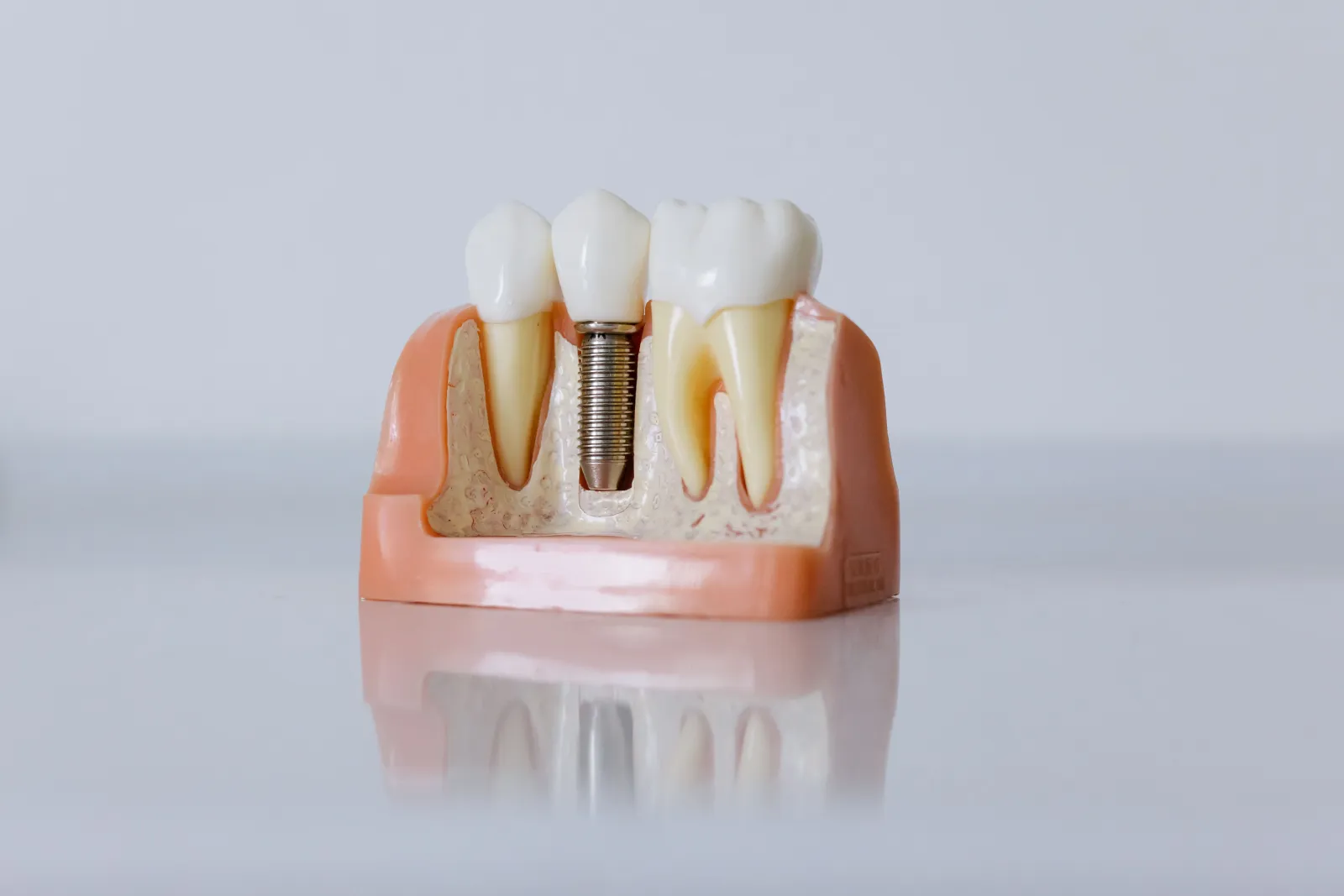
An implant holds because bone grows directly onto the titanium post, a bond dentists call osseointegration. Our post on how implants stay in place walks through how that bond forms. Failure means the bond either never formed or was lost later on.
A 2022 review in Cureus defines early failure as an implant that moves before the final tooth goes on. Late failure comes once the bond has formed and the implant is in use, when something wears the bond away.
A Swedish study of 2,765 randomly selected implant patients counted how often each happens. Early loss hit 1.4% of implants. Among the patients examined nine years later, another 2.0% of implants had been lost late. Smokers and people who had gum disease when treatment began had higher odds of early loss.
What stops the bone from bonding in the first place?
New bone grows onto the titanium while the site heals, and it needs the post to stay nearly still while it does. A 1998 review of loading studies found the limit was not zero movement. Bone tolerated somewhere between 50 and 150 microns, a fraction of a millimeter. Past that, the body fills the gap with soft, scar-like tissue instead of bone, and the implant stays loose. The Cureus review describes the same thing in people who grind.
So the early causes on the review's list share a theme: something let the post move, or slowed the bone down. A post set in thin or soft bone has less holding it still while healing starts. Drilling that overheats the bone injures it, and the review names overheating as part of the surgical trauma that slows healing. An infection at the site can stall healing altogether.
Smoking belongs on this list. A 2015 meta-analysis in the Journal of Dentistry pooled 107 studies covering about 80,000 implants. Smokers had more infections after surgery and more bone loss around the implant. Their implants failed 6.35% of the time, against 3.18% in non-smokers, which is roughly double. The authors caution that other differences between the two groups may also play a part.
Diabetes is less clear-cut than smoking. The Cureus review finds little proof that diabetes by itself causes failure, but poorly controlled blood sugar raises the risk of problems after surgery. A 2021 meta-analysis found more bleeding around implants as HbA1c, the blood test for average sugar levels, went up. The Cureus review also lists corticosteroids and bisphosphonates, two kinds of medication that affect bone.
What makes a working implant fail later on?
In a late failure, the implant worked for a while first. Of the late causes the Cureus review lists, two are the ones a patient can do the most about.
Gum disease around the implant
Plaque collects on an implant the same way it collects on a natural tooth. The 2017 World Workshop consensus on peri-implant disease set the definitions dentists now use. It names plaque as the cause of peri-implant mucositis, inflamed gum around an implant whose main sign is bleeding when gently probed. Peri-implantitis is the plaque-associated condition that goes further: inflamed gums plus steady loss of the bone holding the implant. That bone is the bond, and once enough of it is gone, the implant loosens.
The workshop's review of peri-implantitis found strong evidence for three risks: a history of gum disease, poor plaque control, and no regular maintenance after treatment. It called the data on smoking and diabetes for this late problem inconclusive. It also found that the disease can start early and tends to speed up once it starts. That is why a history of gum disease, and any gum disease treatment it needs, belongs in the implant conversation.
Grinding and heavy biting
A natural tooth sits in a thin ligament that cushions a hard bite and reports it to the brain. An implant fuses straight to the bone with no ligament. A 2019 review of implant overload explains that the force then goes directly into the bone. It also notes that an implant is about eight times less sensitive to touch than a tooth.
Grinding or clenching at night puts heavy force on an implant. The overload review says that force is likely even higher than on a natural tooth, because the implant feels so much less. A 2025 meta-analysis linked grinding to loosened and broken screws, chipped porcelain and fractured implants. The Cureus review advises a guard for anyone who grinds. You wear a night guard over your teeth while you sleep, so the grinding lands on the guard rather than straight on the implant crown.
Who controls which part of the risk?
What the dentist controls
The dentist controls where the implant goes and how much load it carries while the bone forms. At Westlake, we plan implants on a 3D X-ray that shows how much bone is there and where the nerve and sinus sit. We set the position on that scan, and a surgical guide printed from your own anatomy carries the plan into your mouth. That way the errors are made on the computer, not in your mouth. When the scan shows too little bone, a bone graft can rebuild it, and that work is part of our in-house oral surgery.
What you control
Smoking is the risk factor with the clearest numbers behind it, so it is the first one worth changing. If you have diabetes, steady blood sugar matters more than the diagnosis itself. Tell us about any medication you take that affects your bones.
After the tooth goes on, an implant needs the same daily brushing and cleaning between teeth as a natural tooth. The Cureus review advises a professional cleaning and checkup at least once a year. If you grind, wear the night guard every night rather than on the nights you remember.
One thing worth asking for: the consensus report recommends a baseline X-ray and gum measurements once the final tooth is on. That gives every later checkup a starting point, so slow bone loss shows up as a measured change.
What are the warning signs, and can a failed implant be replaced?
Our post on bleeding after implants covers what to expect in the first days after surgery. Months or years later, call us if the gums around the implant bleed when you brush or floss. Swelling, pus or gum pulling back from the implant are reasons to call too.
A crown that feels loose can be the small screw that holds it, not the implant itself. Either way, it is worth a call. The Cureus review stresses catching a failing implant as early as possible, before more bone is lost.
The review describes three routes to a replacement. A wider implant can go in right away. A new implant can go in at the same visit while bone is rebuilt around it. Or the lost bone is rebuilt first, and the new implant goes in once the site has healed. How much bone is left decides the route, and an X-ray answers that.
How do you find out your own risk?
Your risk depends on your bone, gums, health history and bite, so it comes from an exam. If you are still deciding, what to expect when getting dental implants walks through the visits, and the dental implants page covers the options. If you already have an implant that worries you, bring any X-rays you have to the visit.
Book an appointment or call (703) 444-5108.
More from the journal
- Can an Early Cavity Be Stopped Without a Drill?Yes, while the decay is still inside the enamel. At that stage a liquid applied to the tooth…
- Wisdom Teeth Removal Recovery: What Each Day Looks LikeSwelling usually peaks on days two and three, and the usual recovery takes about a week. Most…
- How Much Do Veneers Cost? What Sets the Price per ToothVeneers cost is set by the material, how many teeth are in the design, and what has to be fixed…