
You have just been told a tooth needs a crown. Maybe you had one years ago and wore a plastic temporary while a lab made the real one. So the first thing you want to know is how many visits this one will take.
Same day crowns are real, and most single crowns on back teeth qualify. Some crowns still go to a dental lab, and they go there on purpose. Two things decide it: what the crown is made from, and how much of your bite is changing at once.
How do same day crowns get made in one visit?
Both lanes start the same way: the tooth is numbed and shaped so a crown can sit over it. Then a digital scan records the tooth, its neighbors and the way your top and bottom teeth meet. The scan replaces the tray of impression putty. The crown is designed on screen from it and fitted to your bite before anything is made.
The two lanes split at the next step, and in the same-day lane the design goes to a mill in our office. The mill carves the crown out of one solid block of tooth-colored material while you wait. We check it against your bite, adjust it and cement it at the same appointment, with no temporary and no second visit.
Our technology page explains the scanning and design side in more depth. The same digital workflow runs for a single crown and for a large case.
Why does a single back tooth usually qualify?
A back tooth does most of the heavy chewing, so its crown takes that force over and over for years. It also sits where few people ever see it up close.
A crown carved from one block suits that job. A 2021 review of chairside materials states that in chairside work, single-material crowns are preferred. The reason it gives is mechanical: the main mechanical problem with two-layer crowns is the outer ceramic chipping off the core. A crown cut from one block has no outer layer to chip.
That fits the split at our office, where a single crown on a back tooth is the usual same-day case. On a molar, having no outer layer to chip off counts for more than layers of shade.
Why do some crowns still go to a dental lab?
A front tooth has a different job. It bites through food rather than grinding it, and it sits in the middle of your smile. Look at a front tooth in good light and the biting edge looks slightly see-through, because some light passes through the enamel. How much gets through varies from person to person. In a study of 120 people, front-tooth enamel translucency differed by age and ethnic background.
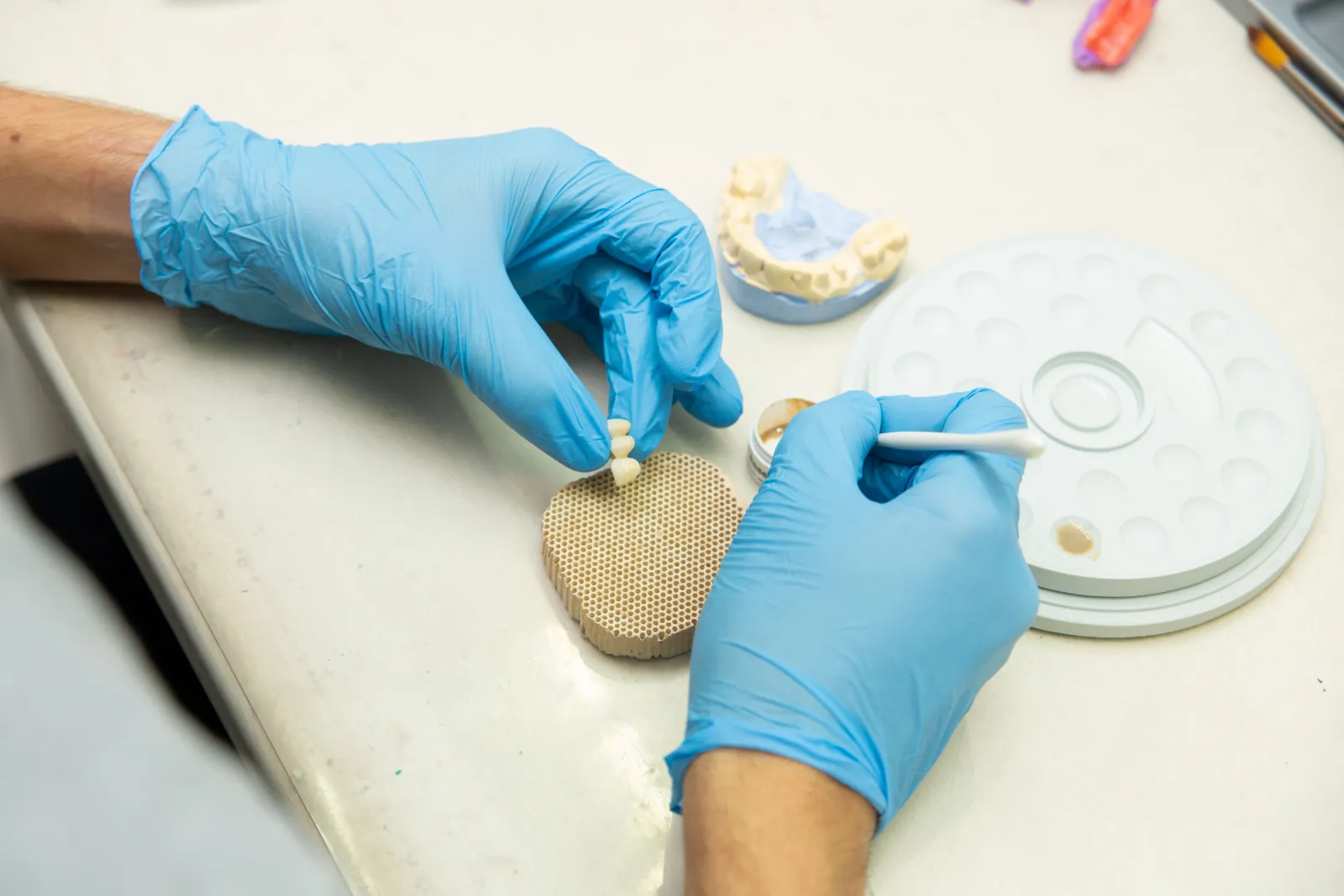
So there is no standard front-tooth shade to copy. When a front crown has to match the teeth beside it that closely, it becomes lab work. A technician builds the crown up by hand in layers of porcelain, each one a slightly different shade and translucency. That takes a bench and time, so you leave the first visit with a temporary. The finished crown is fitted at a second visit once it comes back.
If you also want whiter teeth, the order matters. Whitening comes first, then about a week for the color to settle, and only then is the crown's shade taken. A crown keeps the shade it was made in, which our post on whether crowns can be whitened explains.
If you are deciding between a crown and a veneer on a front tooth, our post on how that choice gets made covers it.
Why is full-mouth rehabilitation done in two visits on purpose?
Full-mouth rehabilitation rebuilds many teeth at once, and often changes how your bite meets. That is a large change to make in one sitting. So the temporaries are planned as a trial run of the new shape and the new bite.
While you wear them, you find out how the new shape feels when you eat, talk and smile. If a tooth turns sensitive, it gets dealt with while the temporary is still easy to remove. The final crowns go in only after that trial. If a problem shows up at that stage, the fix is to a temporary, not to a finished crown already cemented in place.
Does a same-day crown last as long as a lab crown?
Long-term data exists for crowns milled in the office. One clinical study followed 34 chairside crowns on premolars and molars, placed in 2006 and 2007. The authors reported a 15-year survival rate of 80.1%.
The useful detail is how the failures happened. Six crowns failed in that study, and only one of those was the crown itself breaking. The other five came from the tooth underneath. The causes were an infection at the root tip, a fractured tooth or root, and new decay at the crown's edge.
That is one material in one small study, so it cannot predict how long your crown will last. What it does show is where the risk sits. The seam where a crown meets the tooth is still natural tooth, and decay can start there. Cleaning along that edge and coming in for checkups matters in either lane, whether the crown was milled here or made by a lab.
How do you find out which lane your tooth is in?
The exam decides it. We look at where the tooth sits and whether it is one crown or part of a larger rebuild. We also check how closely it has to match the teeth around it. Then we tell you which lane it is in: milled here in one visit, or built by the lab across two.
Sometimes the answer is that the tooth does not need a crown yet. Our post on when we watch a tooth instead of crowning it explains how that call is made. If cost is on your mind, what a dental crown costs in Sterling covers what sets the number.
Our dental crowns page covers each step of both lanes. To have your tooth looked at, book an appointment or call (703) 444-5108.
More from the journal
- Can Gum Disease Be Reversed? Gingivitis vs PeriodontitisGingivitis, which lives in the gums alone, can be reversed with professional cleaning and daily…
- Chipped Tooth: When Bonding Is Enough and When It Is NotThe size of the chip and where it sits decide the repair. A small chip in the enamel is…
- How Much Does Professional Teeth Whitening Cost?Teeth whitening cost follows three things: how strong the gel is, how well it stays on your…